
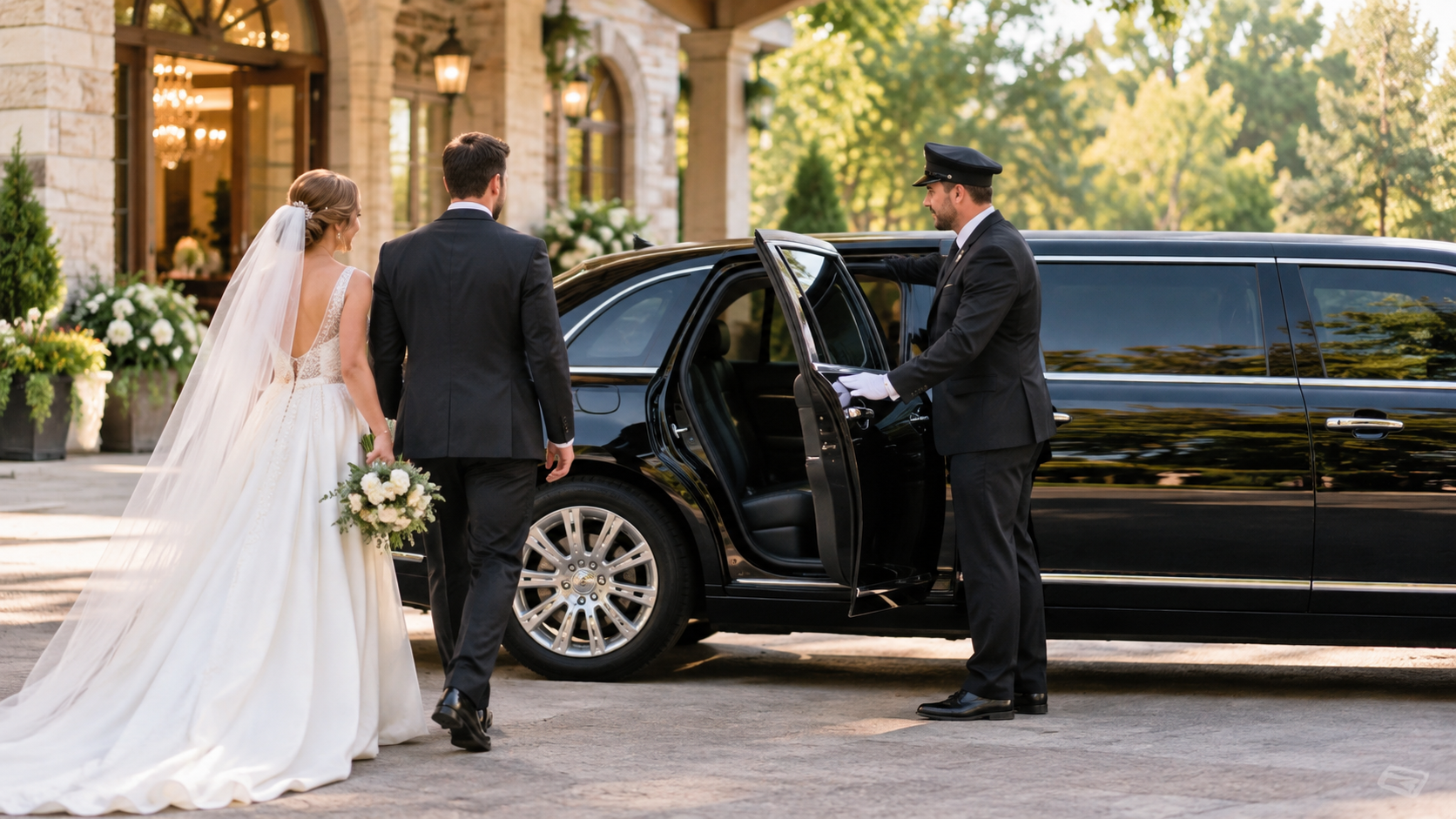
The best wedding transportation in the Twin Cities comes from a company that owns and maintains the vehicles you'll ride in, lets you see them before you book, staffs them with vetted professional chauffeurs, and can show you its Minnesota permit and proof of insurance. Start by mapping every ride your wedding day needs. Then compare companies on those points, and get the vehicles, hours, and pricing terms in writing before you sign.
Total Transportation is a Minneapolis chauffeured transportation company, and we've been part of Twin Cities weddings since 1987, when Dave Murray started the business with a single six-passenger stretch limousine. The same family still runs it, now with around 60 chauffeured vehicles plus motorcoaches. This guide covers how to plan your wedding transportation, what it typically costs, and how to vet any company before you sign, including ours.
Start by Mapping Every Ride on Your Wedding Day
Before you call a single company, write down every movement your day requires. That list decides how many vehicles you need and how many hours you'll book, and those two numbers drive most of the cost.
A typical Twin Cities wedding day includes some mix of rides from getting-ready locations to the ceremony, stops for photos, the move from ceremony to reception, the couple's getaway at the end of the night, and guest runs between hotels and venues. For each ride, note who is riding, the pickup time, and both addresses.
Once it's on paper, patterns show up. The bridal party might need a vehicle for the first half of the day, while guests only need shuttles in the evening. Booking those separately keeps you from paying for a 20-passenger vehicle to sit in a parking lot for three hours.
Which Wedding Vehicle Fits Each Group?
The couple, the bridal party, parents and VIP family, and guests usually need different vehicles. Here's how common wedding vehicles match up with the people riding in them.
Book each vehicle with room to spare. A limousine filled to its listed capacity gets tight fast once you add gowns, bouquets, and a photographer climbing in and out. We recommend planning a few seats below each vehicle's maximum.
Because our fleet runs from executive sedans and luxury SUVs to stretch limousines and 56-passenger motorcoaches, we can put the couple, the bridal party, family, and guests on one reservation. Every handoff between vehicles is a point where a wedding schedule can slip, so it helps to have one company coordinating all of them.
When Does a Wedding Guest Shuttle Make Sense?
A guest shuttle makes sense when your ceremony and reception are far apart, parking at the venue is limited, many guests are staying at hotels, or you expect guests to drink at the reception. The Knot suggests considering transportation for all guests when the venues are more than 30 minutes apart.
A shuttle also settles the question of who's driving home. When guests ride back to the hotel together, nobody has to leave early to stay sober for the drive.
Run the shuttle as a loop with set departure times. Several round trips between the venue and the hotel let older guests head out early while everyone else stays for the last dance. Post the departure times on your wedding website and at the reception so guests always know when the next shuttle leaves. We typically handle these runs with our shuttles, mini coaches, and motorcoaches, depending on guest count.
If guests will be drinking on the way, Minnesota's open-bottle law allows passengers to drink in a permitted limousine service or in a bus operated by a registered passenger carrier. The exception covers passengers only, and anyone under 21 still can't drink.
How Far in Advance Should You Book Wedding Transportation?
Book wedding transportation three to six months before the wedding, and closer to six months for a May or June date. The Knot recommends booking once your date and venues are set, and moving earlier for spring weddings, when prom and graduation season competes for the same vehicles.
Minnesota gives you another reason to book early. Our warm-weather wedding calendar is short, so demand for Saturdays from late spring through October piles into a few months. Fall is also the busiest wedding season nationally. The Knot's data shows 35% of couples marry between September and November, and October and June tie as the most popular months, at 16% of weddings each. If you're planning a Saturday in September or October, treat transportation like the venue or the photographer and lock it in early.
How Does Wedding Transportation Pricing Work?
Most wedding transportation is priced by the hour with a minimum booking. Your total depends on how many vehicles you need and how long each one is reserved. Couples who married in 2025 spent an average of $1,100 on transportation, according to The Knot's 2026 Real Weddings Study.
The Knot's prior-year data put the Midwest average at $934. Spending also climbs with guest count, from $583 for weddings with 50 or fewer guests to nearly $1,200 for weddings with more than 100, according to The Knot's wedding transportation cost breakdown.

What Is an Hourly Minimum?
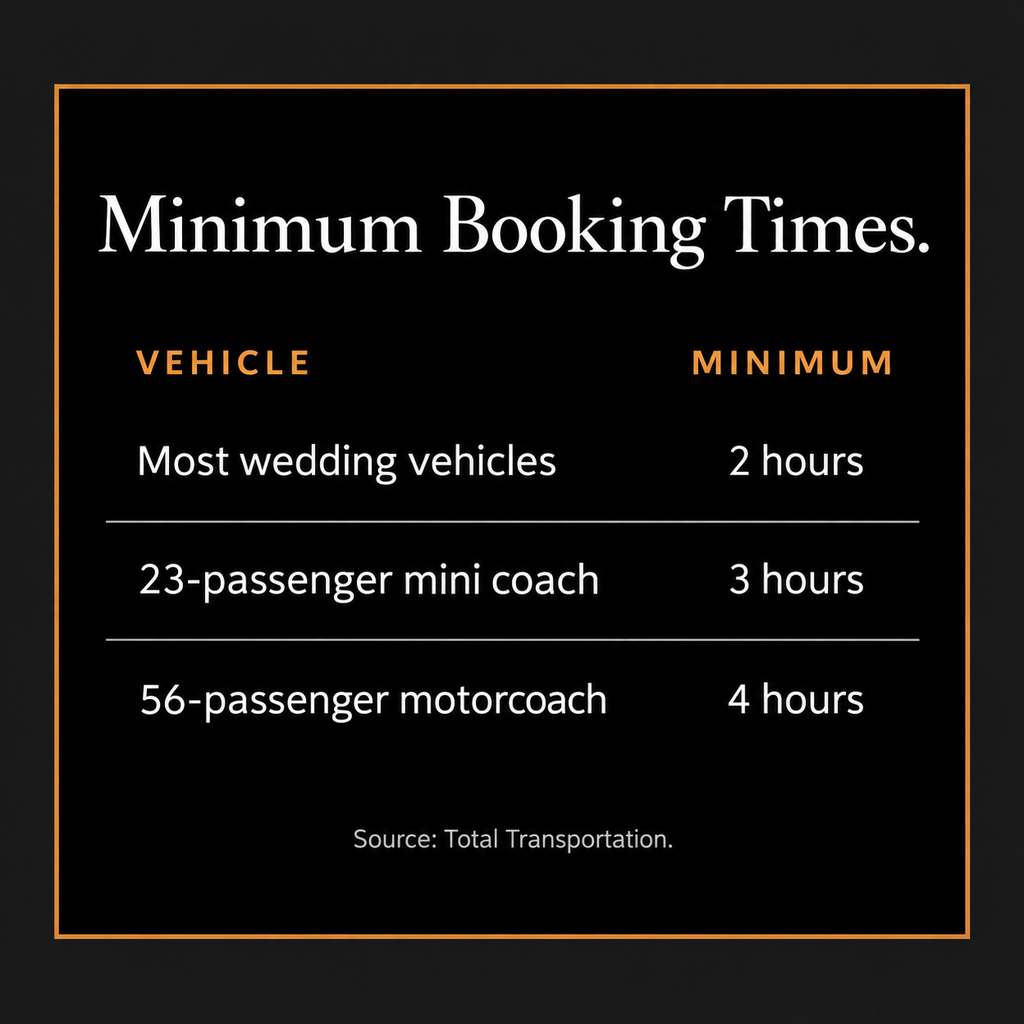
An hourly minimum is the shortest block of time a company will book a vehicle for. It exists because the vehicle and chauffeur are committed to your date whether you use the full time or not. The Knot describes three hours as a typical minimum.
At Total Transportation, most wedding vehicles carry a two-hour minimum. Our 23-passenger mini coach has a three-hour minimum, and our 56-passenger motorcoach has a four-hour minimum.
The best way to control cost is a tight itinerary. Book each vehicle for the part of the day it's actually needed instead of holding every vehicle for the full event.
What Can Add to Your Wedding Transportation Bill?
The hourly rate is only part of the quote. Ask each company how it handles overtime if the reception runs late, wait time, extra stops, and gratuity. The Knot notes that gratuity typically runs 15% to 20% and may already be built into the contract, and that sales tax can apply.
Also ask when the clock starts. Some companies bill garage to garage, which New York City's Taxi and Limousine Commission defines as charging from the moment the vehicle leaves the garage until it returns. Others start billing at your first pickup. Both are common, and the difference can add real time to a quote.
Get every detail in writing. That includes the date, pickup times and addresses, the specific vehicles, the hours booked for each one, deposit and cancellation terms, and whether gratuity is included. State regulators such as the California Public Utilities Commission give consumers the same advice, recommending a written agreement that covers cost, deposit, refund and tip policies, and the specific vehicle before hiring a limousine.
How to Vet a Wedding Transportation Company
Many wedding-day transportation problems come down to things a couple could have checked ahead of time, like who owns the vehicle, who your chauffeur will be, and whether the company is licensed and insured. Here's what to check and why each one matters.
Does the Company Own Its Vehicles or Broker the Job?
Ask whether the company owns and maintains the vehicle you'll ride in. Some businesses that sell wedding transportation are brokers. Federal law defines a broker as someone who arranges transportation by a motor carrier without providing it. Minnesota's limousine rules draw the same line. An operator owns or leases the limousine, and a broker only arranges the trip.
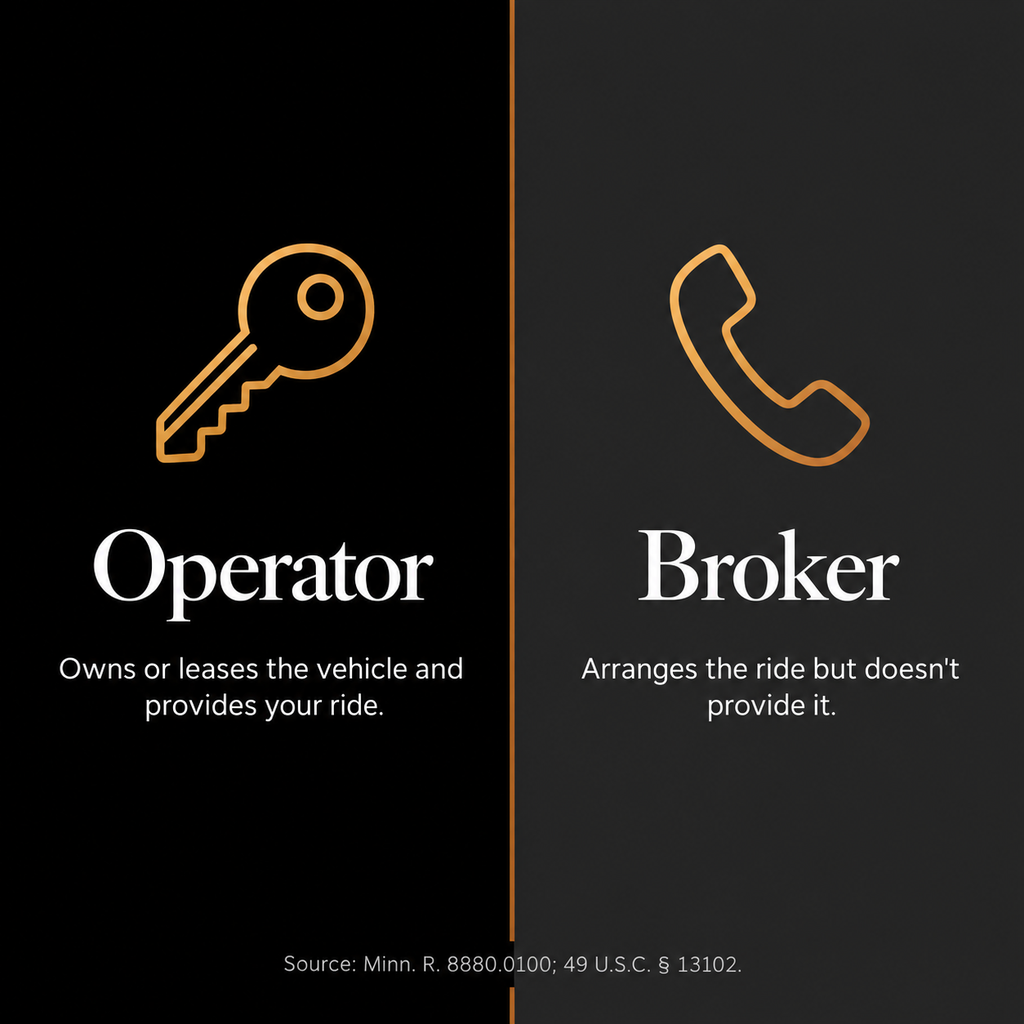
A broker can still book you a good ride, but it puts another company between you and the vehicle. The business you paid may have no say in how that vehicle was maintained or who shows up to chauffeur it.
That's the reason we keep everything in house. At Total Transportation, our fleet is maintained, repaired, detailed, and fueled at our own 50,000-square-foot facility, so the vehicle that pulls up on your wedding day is one our own mechanics have worked on.
Can You See the Vehicle Before You Book?
A reputable company will let you see the actual vehicle you're booking in person. The Knot recommends making the final reservation in person so you can inspect the vehicles. The Virginia DMV's limousine guidance advises asking to see the specific limousine, checking that it's clean, and confirming every seat has a working seat belt.
When you visit, ask which vehicle will be assigned to your wedding and look at the interior with your wedding party's size in mind. Check that the company name on the vehicle matches the name on your contract.
We're glad to show couples their vehicle before they book, and it comes up again and again in our reviews.
How Are the Chauffeurs Hired, Trained, and Dressed?
Minnesota sets a baseline for anyone chauffeuring a permitted limousine. Under the state's updated limousine rules, a chauffeur must be at least 18, carry a valid DOT medical examiner's certificate, have a driving record free of specified offenses (including DWI-related convictions) for the past three years, and pass a criminal background screen covering the past ten years. The company must check driving and criminal records before hiring and every year after.
Anything beyond that baseline is company policy, so ask about it. Federal drug and alcohol testing applies to chauffeurs who need a commercial driver's license, which covers vehicles designed to carry 16 or more people, counting the chauffeur. According to the FMCSA, those testing rules are tied to the CDL, so chauffeurs of sedans, SUVs, and most stretch limousines aren't federally required to be tested.
Also ask whether chauffeurs are employees or contractors, how long they've been with the company, how they're trained, and what they wear. Attire matters more than most couples expect, because your chauffeur ends up in the photos of your arrival and your getaway.
Our chauffeurs are full-time career employees, and some have been with us for up to 30 years. Each one passes a background check, drug and alcohol testing, and approval by our insurance carrier, and every chauffeur works in a black suit, white shirt, and company tie. You can read more about our safety and training standards.
How to Check a Wedding Transportation Company's License and Insurance
Minnesota requires any for-hire limousine service to hold a permit from MnDOT, and every permitted limousine must display an annual MnDOT decal. Under rules that took effect December 22, 2025, that decal carries the letters "LM" and sits on the lower passenger-side corner of the windshield. The updated rules also require limousine operators to have a USDOT number and bar them from operating under a name different from the one on their permit.
Larger vehicles such as limo coaches, mini coaches, and motorcoaches fall under Minnesota's separate registration for motor carriers of passengers. A copy of that registration must be carried in each vehicle.
Insurance and licensing requirements step up at 16 seats, counting the chauffeur.
To check a company's federal record, search its USDOT number in the FMCSA's SAFER system. The FMCSA's Look Before You Book guide explains what to look for. A Satisfactory safety rating is the highest. Conditional means some violations were found, and Unsatisfactory generally means the company is not allowed to operate. Not Rated means the company hasn't been evaluated yet, and a company can still be authorized to operate without a rating. Under Licensing and Insurance, confirm that passenger authority shows "Yes" and that active insurance is on file.
Treat SAFER as one check among several. There's no public MnDOT search for permitted limousine operators, so ask the company for its MnDOT permit number and USDOT number, confirm the business name matches your contract, and look for the LM decal when you see the vehicle. You can also call MnDOT's Office of Freight and Commercial Vehicle Operations to confirm a permit, and ask the company for a certificate of insurance.
What Do Couples Say in Reviews?
Read reviews on wedding platforms like The Knot and WeddingWire as well as on Google, and focus on recent ones. Look for patterns in how couples describe punctuality, vehicle cleanliness, the chauffeur's professionalism, and how the company handled anything that went wrong. One review about a late pickup is worth noting. Several describing the same problem is a pattern.
How Will the Company Communicate Before and on Your Wedding Day?
Ask how the company confirms your booking and how you'll know where the vehicle is on the day. You shouldn't have to call a dispatcher from the ceremony venue to find out whether the limousine is on its way.
Every Total Transportation reservation gets a confirmation, a second confirmation 24 hours before pickup, and a text when the chauffeur is en route with the chauffeur's name, photo, and a live tracking link. A live person answers our phone 24 hours a day, 365 days a year, which helps when a wedding timeline changes late the night before.
What Happens If a Vehicle Has a Problem?
Ask each company what happens if the vehicle assigned to your wedding has a mechanical issue that morning. The answer depends a lot on fleet depth. A company with one vehicle of each type has fewer options than one with several vehicles of the same type and its own shop. If the answer affects your decision, get it in writing.
How to Plan Wedding Transportation Around Minnesota Weather
Winter and shoulder-season weddings in Minnesota need extra time built into every ride. The Twin Cities average 51.2 inches of snow a year under the 1991 to 2020 climate normals, with December and January each averaging about 11 inches. April still averages 3.5 inches, so spring weddings can see snow too. The median date of the first inch of snow in the Twin Cities is November 15, according to the Minnesota DNR.

For a winter wedding, ask the company how it handles snow days, plan covered spots for photos and loading, and give the bridal party a warm place to wait so nobody is standing outside in a gown in January.
How Much Buffer Time Should You Build Between Wedding Venues?
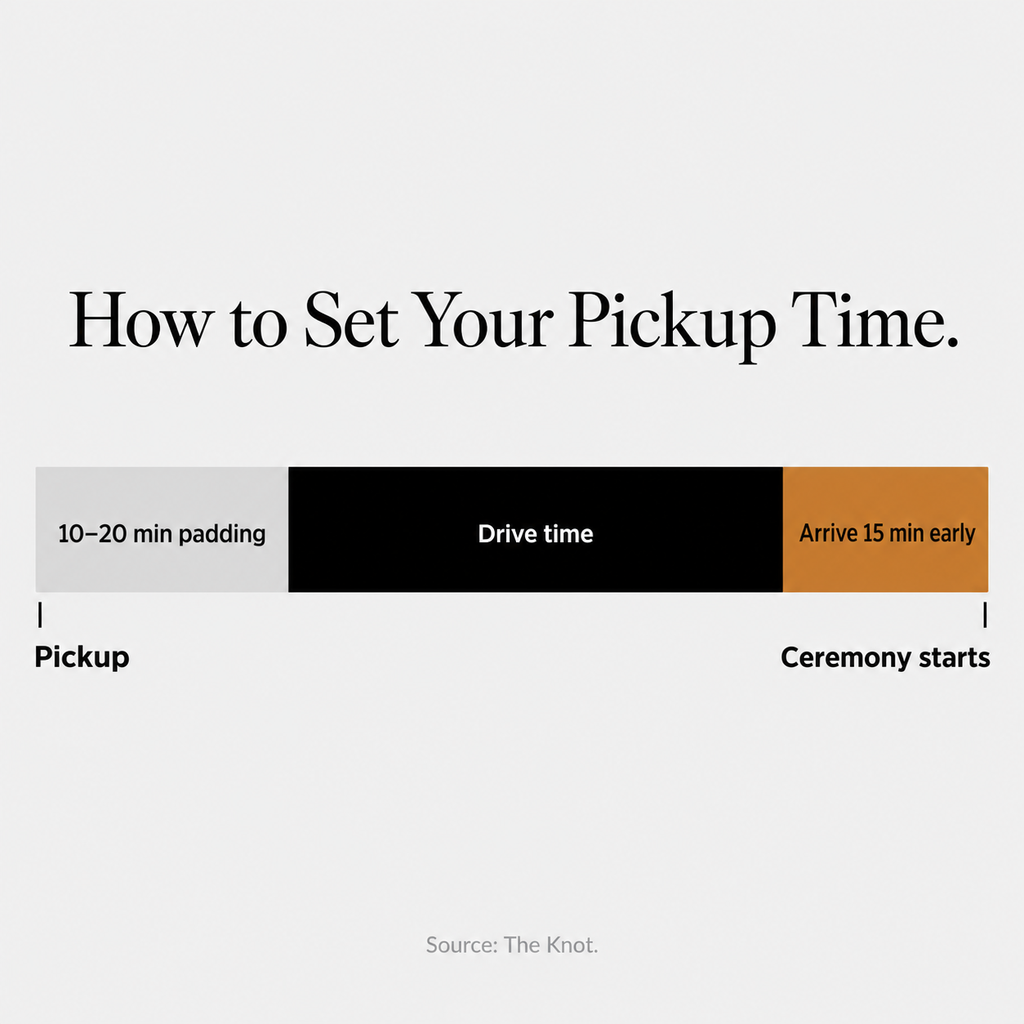
Plan 10 to 20 minutes of padding on every ride, on top of the normal drive time. The Knot's method is to aim to arrive 15 minutes early, subtract the drive time, and then add that padding for traffic and loading. Test the route on the same day of the week and at the same time of day as your wedding.
Drive times across the metro vary more than most couples expect. A ride from downtown Minneapolis to a venue near Stillwater or Lake Minnetonka can change a lot with Saturday events, summer road construction, and weather. Add more padding for a January wedding or an October Saturday downtown, and tell your transportation company about any concerts, games, or festivals near your venues that day.
Questions to Ask a Wedding Transportation Company Before You Sign
Bring these questions to every company you're considering.
- Do you own and maintain the vehicle we'll ride in?
- Can we see our actual vehicle before we book?
- What are your MnDOT permit and USDOT numbers?
- Can you send a certificate of insurance?
- Are your chauffeurs employees or contractors?
- Do your chauffeurs go through drug and alcohol testing?
- What will our chauffeur wear?
- What is the hourly minimum for each vehicle?
- Does billing start at your garage or at our first pickup?
- How do you charge for overtime, wait time, and extra stops?
- Is gratuity included in the quote?
- What are your deposit and cancellation terms?
- How will you confirm our booking and update us on the day?
- What happens if our vehicle has a mechanical problem?
- How do you handle snow or severe weather?
Book Your Twin Cities Wedding Transportation With Total Transportation
When you're ready to plan your wedding transportation, we'd be glad to help. Our family has been handling Twin Cities weddings since 1987, from the bridal party's first ride to the last guest shuttle of the night and the getaway we've long called the Honeymoon Express. We'll help you map out your day, match the right vehicle to each group, and show you those vehicles in person before you book.
We're a Hall of Fame wedding transportation company on The Knot, and we hold a 4.9-star rating across hundreds of Google reviews.
See how we handle wedding transportation, or contact our team for a quote. You can also email our weddings and events team at weddingsandevents@totallimo.com or call (651) 770-5668. A live person answers around the clock.
For faster booking, reporting and receipts, download our app


